Examining the relationships among parents' marital satisfaction, parenting self-efficacy, and children's emotional regulation skills, with positive responsive parenting serving as a mediating factor
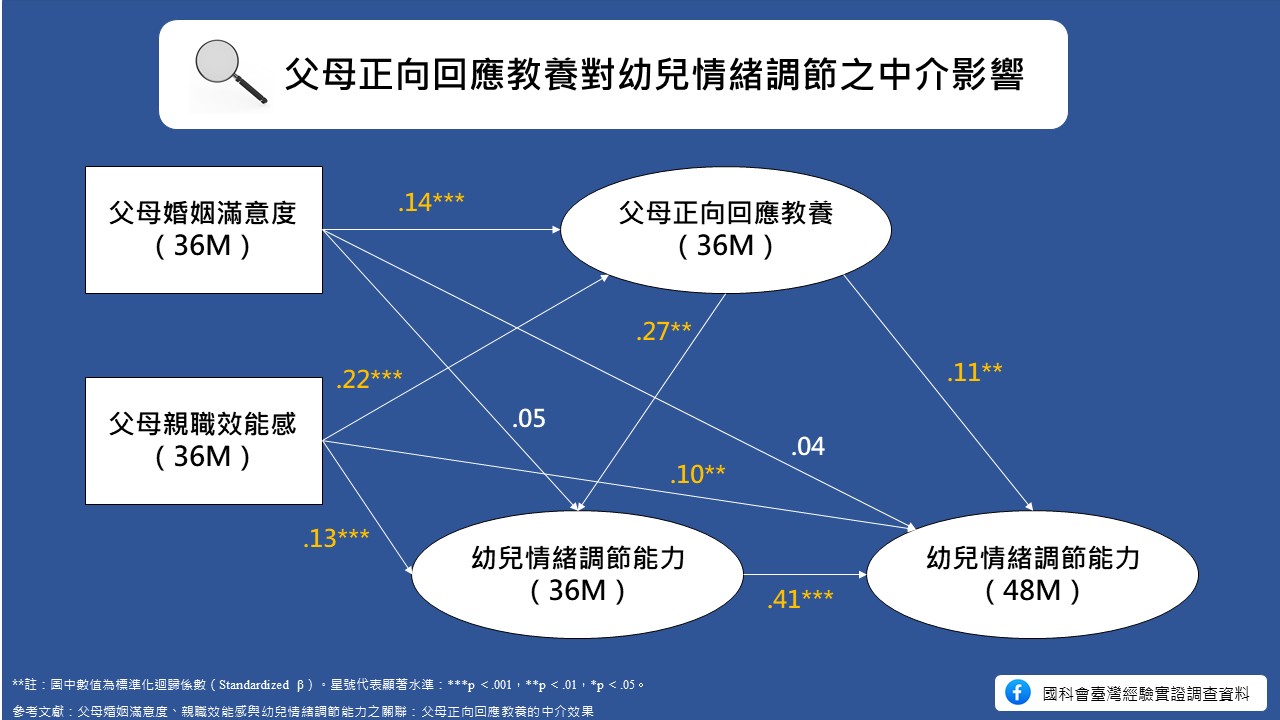
A research team led by Associate Professor Miao-Ju Tu (Fu Jen Catholic University) and Associate Professor Li-Tuan Chou (National Taiwan Normal University) analyzed data from the Kids in Taiwan: National Longitudinal Study of Child Development and Care (KIT). They examined the relationships among parents' marital satisfaction, parenting self-efficacy (confidence in their parenting ability), and children's emotional regulation skills, with positive responsive parenting serving as a mediating factor.
🔍 Key Findings
Parents’ marital satisfaction and parenting self-efficacy indirectly influence children’s emotional regulation through positive parenting interactions.
Among these, parenting self-efficacy exerts an even stronger effect than marital satisfaction itself.
In other words, as long as parents believe in their ability to parent effectively and respond to their children’s emotions with warmth and attentiveness, children’s EQ can develop steadily regardless of other family dynamics.
🎯 Implications for Parenting
When parents frequently engage in practices such as encouraging emotional expression and assisting children in managing negative emotions, while avoiding criticism, emotional neglect, or dismissive responses, children are more likely to regulate emotions constructively. Instead of resorting to tantrums or aggressive behavior, they learn to communicate their needs verbally and seek support in adaptive ways.