Identifying several institutional and methodological factors that may contribute to forecasting bias
Public opinion surveys are a primary tool for understanding societal views on political, economic, and policy-related issues. Through questionnaire design and statistical sampling, polls aim to reflect overall public sentiment, providing references for policymakers and the general public. However, even when methods appear rigorous and data look precise, discrepancies frequently arise between pre-election polling predictions and actual voting outcomes.
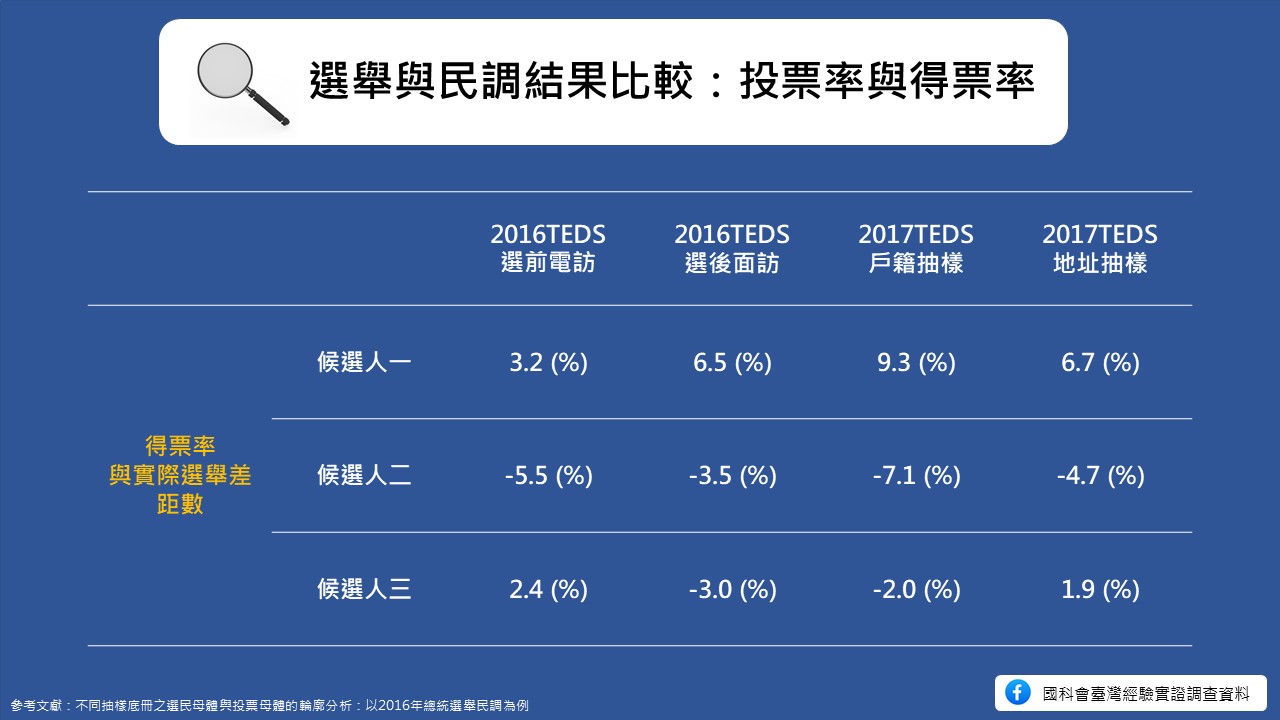
To examine this phenomenon, Professor Wen-Chung Chuang (Shih Hsin University), Assistant Professor Mei-Jung Lin (Tamkang University), and Professor Emeritus Yung-Tai Hung (National Taiwan University) analyzed data from the Taiwan’s Election and Democratization Study (TEDS) collected in 2016 and 2017. Their work explored the divergence between polling results and the 2016 presidential election outcomes, identifying several institutional and methodological factors that may contribute to forecasting bias.
✅ Why Do Polls Fail? Possible Explanations
Sampling limitations: Polls often rely on residential landlines, household registries, or address lists. Each source captures different population groups. For example, landline-based surveys may exclude “mobile-only users,” while household registries may fail to reach young adults or migrants who live away from their registered addresses.
Sampled respondents ≠ actual voters: Polling respondents are typically “eligible voters,” but not all of them turn out to vote. Actual voters are disproportionately older and more motivated, producing a systematic gap between poll predictions and election outcomes.
Challenges in weighting adjustments: Although weighting is applied, high levels of non-response, refusal to participate, or social desirability bias (providing “acceptable” answers rather than true preferences) undermine precision.
Despite TEDS’s rigorous stratified sampling and weighting procedures, and its sample alignment with Taiwan’s overall voter demographics, discrepancies with actual turnout remained. This does not imply that polls are meaningless; rather, it highlights that even the most scientific methods have inherent limitations. Polls remain valuable for capturing public attitudes and societal trends.
✅ Recommendations for Improving Poll-Based Election Forecasts
Integrate diverse data sources to enhance coverage: Combining mobile phone surveys, online polling, and voter registries can offset the shortcomings of any single sampling method, increasing diversity and representativeness.
Strengthen behavioral prediction and modeling: Incorporating past voting behavior and individual characteristics, along with more nuanced turnout intention measures and machine learning techniques, can yield more accurate forecasting models.
Prioritize trend analysis and issue tracking: Instead of focusing solely on the accuracy of election outcome predictions, polls should emphasize their value in detecting shifts in public opinion, identifying salient issues, and tracking voter psychology over time.